Download Books Extraordinary Tales Online
Details Containing Books Extraordinary Tales
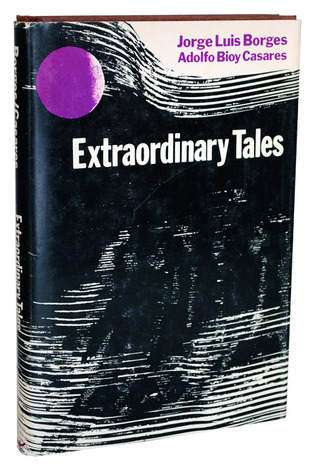
| Title | : | Extraordinary Tales |
| Author | : | Jorge Luis Borges |
| Book Format | : | Hardcover |
| Book Edition | : | First American Edition |
| Pages | : | Pages: 144 pages |
| Published | : | 1971 by Herder and Herder (first published 1955) |
| Categories | : | Fiction. Short Stories. Fantasy |
Jorge Luis Borges
Hardcover | Pages: 144 pages Rating: 4.18 | 515 Users | 38 Reviews
Narrative Supposing Books Extraordinary Tales

The great Argentinian literary artists Jorge Luis Borges and Adolfo Bioy Casares have compiled over ninety tales of the fantastic, strange, imaginative, and, yes, the extraordinary - tales from around the world, from all times and places, ancient and modern, East and West. Some of the tales are as short as one or two or three lines, most one page and a few others two, three or four pages.. Highly recommended for your reading pleasure. Here are several of the shorter tales I particularly enjoyed, including the last tale by Adolfo Bioy Casares where I have also included my brief commentary:
THE WORK AND THE POET by R. F. Burton (1887)
The Hindu poet Tulsi Das composed the “Geste” of Hanuman and his army of monkeys. Years later, he was imprisoned in a stone tower by a king. In his cell he put himself to meditating, and from out of his meditation emerged Hanuman and his army of monkeys, and they conquered the city, burst into the tower, and freed Tulsi Das.
EUGENICS by Drummond (1618)
A lady of quality fell so deliriously in love with a certain Mr. Dodd, a Puritan preacher, that she begged her husband to allow her to use the marital bed for purposes of procreating an angel or a saint, but, permission having been granted, the birth was normal.
THE CASTLE by Diderot (1773)
Thus he arrived before a great castle on which façade were carved the words: I BELONG TO NO ONE AND TO ALL. BEFORE ENTERING YOU WERE ALREADY HERE. WHEN YOU LEAVE YOU WILL REMAIN.
THE DREAM OF CHUANG TZU noted by Herbert Allen Giles (1889)
Chuang Tzu dreamt he was a butterfly, and when he awoke, did not know if he was a man who had dreamt he was a butterfly or a butterfly who was dreaming he was a man.
THE MIRACLE noted by W. Somerset Maugham (1949-1951)
A Yogi wanted to cross a river and had not the penny to pay the ferryman, so he walked across the river on his feet. Another Yogi hearing of this said the miracle was only worth the penny it would have cost to cross by ferry.
SALVATION by Adolfo Bioy Casares (about 1955)
This is a story out of past times and kingdoms. A sculptor was walking in the garden of the palace in the company of a tyrant. Beyond and behind the Labyrinth for Illustrious Foreigners, at the far edge of the Grove dedicated for Decapitated Philosophers, the sculptor presented the tyrant with his latest work: a water-nymph as fountain. While the sculptor grew prolix with technical explanations and expanded in the intoxication of triumph, he began to notice a menacing shadow crossing the handsome face of his protector. He fathomed the cause, “How can a person of such indifferent quality,” the tyrant was surely thinking, “do what I, master of nations, cannot do?” At that moment a bird, which had settled to drink at the fountain, flew off with a flutter of wings in the air, and the sculptor thought of the idea which would save him. “No matter how insignificant they may be,” he said aloud, indicating the bird, “we must recognize that they fly better than we.”
Here are a number of features of this wonderful tale I particularly enjoy:
• Although this might be a direct slap at the current political dictatorship in Argentina of the time, Bioy Casares states directly the tale is of a far distant past, giving it a remote, universal, mythical quality;
• Labyrinth for illustrious foreigners and a grove dedicated to decapitated philosophers sounds ominous. In a modern dictatorship that is exactly the truth: keeping foreigners in the dark about what is really happening in the country and assassinating any free-thinking citizen who dares to disagree;
• The sculptor’s nymph fountain could be seen as a stand in for a fiction writer’s fantastic tale, the kind written by the author himself, his friend Jorge Luis Borges or his wife Silvina Ocampo.
• The artist is proud of his creation and loves to speak at length about the creative process, but such talk makes a powerful politician angry since, compared to an artist or creative writer, the politician is an unimaginative, no-talent power player.
• There could be trouble, but since the artist is especially perceptive and intuitive, he senses danger and, like a hunted wild animal, becomes keenly aware of surroundings - thus catching the flutter of a bird’s wing prompting him to speak the words that save his neck. I can imagine many artists and writers in Argentina and elsewhere on the globe at the time of dictatorship likewise becoming highly intuitive and thereby escaping prison, torture or death.


Be Specific About Books In Favor Of Extraordinary Tales
| Original Title: | Cuentos breves y extraordinarios |
| Edition Language: | English |
Rating Containing Books Extraordinary Tales
Ratings: 4.18 From 515 Users | 38 ReviewsNotice Containing Books Extraordinary Tales
Quedarse pensando por horas al leer relatos que duran segundos. Fascinante selección de mis compatriotas.Maravillosa selección de cuentos breves. La mayoría de no más de media página. Sin duda los que hemos leído a Borges vemos en estos cuentos la chispa de muchos de sus relatos.
Definitivamente este libro es extraordinario. Está compuesto de exquisitos cuentos y microrrelatos, algunos con matiz de parábola. He aquí uno: El día del Juicio Final, Dios juzga a todos y a cada uno de los hombres. Cuando llama a Manuel Cruz, le dice: -Hombre de poca fe. No creíste en mí. Por eso no entrarás en el Paraíso. -Oh Señor -contesta Cruz-, es verdad que mi fe no ha sido mucha. Nunca he creído en Vos, pero siempre te he imaginado. Tras escucharlo, Dios responde: -Bien, hijo mío,
Brilliant.
Que si bien esa frase de "lo bueno, si breve, dos veces bueno" me parece una estupidez, en este caso se podría dar por válida. Espectaculares la totalidad de los cuentos. Entre ellos me gustaron particularmente "La sentencia" de Wu Ch 'eng-en, "Argumentos anotados por Nathaniel Hawthorne", "Cómo descubrí al Superhombre" de G. K. Chesterton, y "Vuelo asistido" de N. Allegre.
Pocas veces un titulo tan bien elegido.Y que antología. Borges y Casares hacen una selección exquisita de cuentos muy cortos, a veces de no mas de un párrafo, llenos de asombro y fantasía.Hace tiempo lo encontré en mis búsquedas de tesoros por Corrientes un sábado a la tarde y desde entonces es uno de mis favoritos.
El título es preciso, el libro es una antología de cuentos universales muy cortos. La simpleza del relato para tan extraordinaria literatura es impresionante. Probablemente esa sencillez que no resta riqueza, sea la principal huella y aporte de los tres autores trabajando en unísono. Asimismo los temas que se tratan en la antología son de carácter universal y de infinitas interpretaciones. Como opinión personal, pienso que es la mejor obra introductoria para después adentrarse en las más
0 Comments